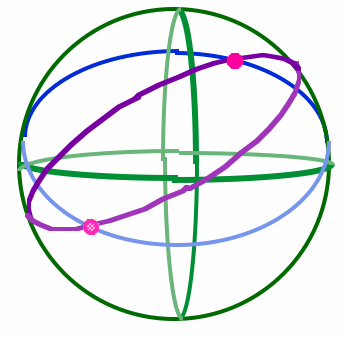
Note: In many of these pictures, the curves appear somewhat wiggly. They are not supposed to be, but I haven't figured out a way to avoid it using the drawing program I use.
- A straight line segment can be drawn joining any two points.
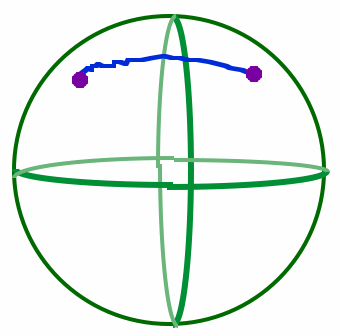
- Any straight line segment can be extended indefinitely in a straight line.
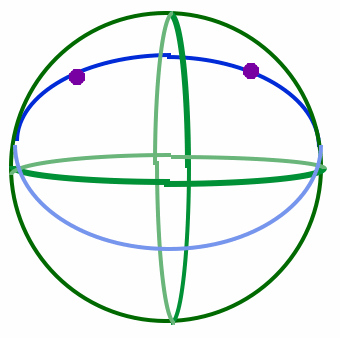
- Lines in spherical space are great circles - circles which go around the "fattest" part of the sphere, or in other words, circles which have as their center the center of the sphere.
- In regular Euclidean space, the line that goes through any two points is unique. In spherical space, whether or not the line is unique depends on whether or not the two points are exactly opposite each other. If they are not, the line will be unique. If they are opposite (antipodal), there will in fact be an infinite number of lines through those two points.
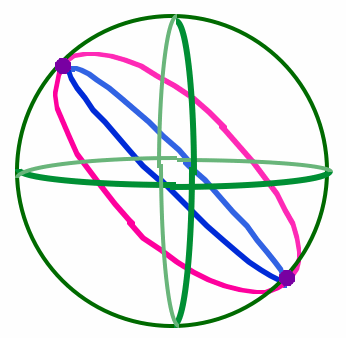
- Given any straight line segment, a circle can be drawn having the segment as radius and one endpoint as center.
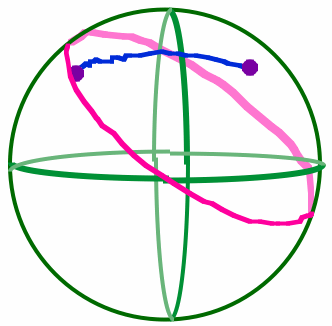
- A circle of radius r in spherical space is defined the same way it is in Euclidean space - the set of all points r units away from the center. Of course, in spherical space, these points all lie on the sphere, including the center, and we measure distance over the surface of the sphere, not through the middle of it.
- All lines in spherical space are also circles in spherical space. *
- Not all circles in spherical space are lines in spherical space. For instance, the above pictured circle, when thought of as planar circle, has as its center some point other than the center of the sphere.
- Some people find that one helpful way to think remember these distinctions is that longitude lines are both lines and circles, while latitudes are only circles.
- All right angles are congruent.
- Rather than look at Euclid's 5th postulate, we'll look at whether the equivalent parallel postulate is true:
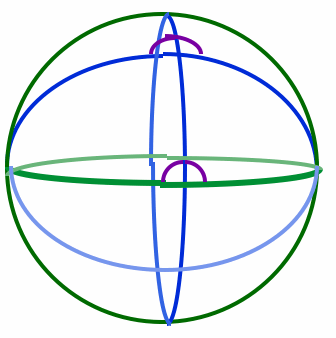
Given any line and a point not on the line, there exists exactly one line through the point that is parallel to the given line.Two lines are parallel if they never intersect. In spherical space, any two lines will intersect (in two places)! (See the illustration below) Thus the parallel postulate (and hence Euclid's 5th postulate) are not true in spherical space, because given any line and a point not on the line, no line through the point and parallel to the line exists.